
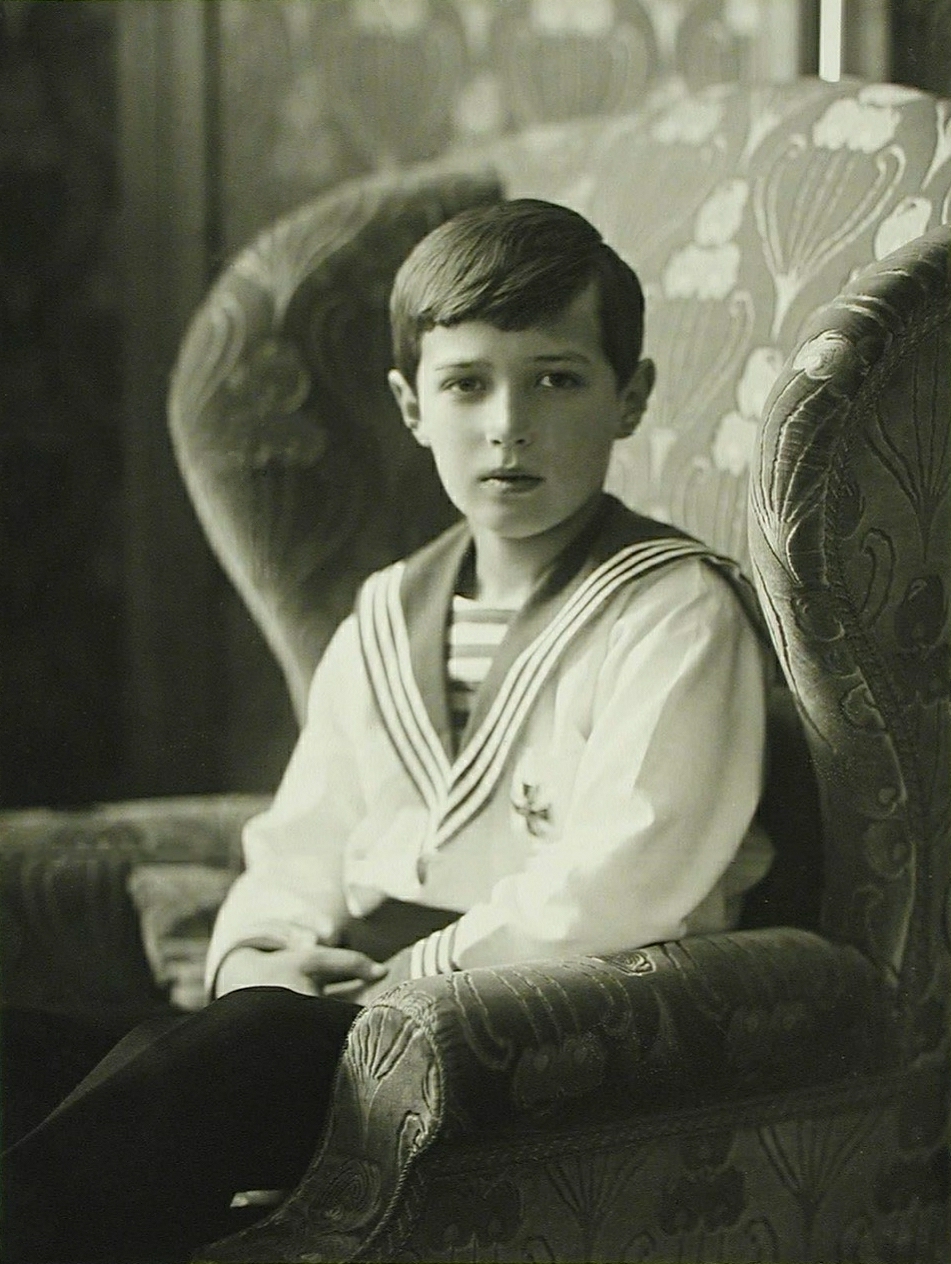
He was born to rule—but his blood wouldn’t let him.”
The fate of the Romanov dynasty hinged on the fragile body of a single boy: Alexis, the Tsarevich of Russia. His illness, and the mysterious man who seemed to heal him, helped usher in the fall of one of history’s great empires.
A Gene from a Queen
Inbreeding among the families of European nobility was partially responsible for the downfall of Czar Nicholas II of Russia. Too many cousins married too many cousins, and the recessive gene for hemophilia was passed on from Queen Victoria of Britain to her granddaughter Alice. Alice herself did not have the disease hemophilia. Like Victoria, she was only the carrier for the gene. Alice went on to marry the Czar-to-be, Nicholas II, and changed her name to Alexandra; together they became Nicholas and Alexandra of the house of Romanov.
On August 12, 1904, the Empress Alexandra gave birth to her fifth child, the boy Alexis. He was the royal heir, first in line to the throne of Russia, and he was a bleeder. Alexis had the genetically inherited disease hemophilia- his blood-clotting mechanism did not clot properly. It was noticed at a very early age that the Tsarevich (royal heir to the throne) bruised easily.

In a human body filled with biological and physiological wonders, blood-clotting is one of the most remarkable processes of all. Think of the problem that God had to solve. He had to make a liquid that would carry the red blood cells from the heart to the distant capillaries of the human body, but the instant that our skin was violated and broken open, the liquid had to begin to solidify (clot) so we wouldn’t keep on bleeding. Behind the clot the blood is still liquid, bringing nutrients to repair the damage. It is a miraculous process.
But Alexis Romanov did not have the proper sequence of chemicals for the blood to clot, so his life was in constant danger. Any slight bump could begin a seepage of blood into the surrounding cells, putting excruciating pressure on the site. One time Alexis nearly died from a nosebleed. Doctors cauterized the injured vein and saved Alexis’ life. Many times, Alexis was in excruciating pain from the pressure of unclotted blood in his joints, but Nicholas and Alexandra steadfastly refused to give Alexis any morphine for the pain, knowing that the drug was habit-forming, and Alexis would become an addict.
In spite of this serious and chronic illness, Alexis was a lively and even mischievous boy who hated being sick. He was notorious for disrupting his father’s troop reviews by riding a bicycle on the parade ground, causing his parents to order the troops to catch him before he fell down.
In 1912, when he was eight years old and vacationing in Poland with his four sisters and parents, Alexis fell and bruised his groin, causing a severe hemorrhage beneath the skin. Pediatricians and surgeons arrived from St. Petersburg to treat the boy, but their combined wisdom was of no avail. The hematoma (bruising) spread throughout the lower left leg and into Alexis’ abdomen. Alexis began to scream incessantly, and he lay on the brink of death for nearly two weeks.
In what was one of the most inexplicable actions taken by Nicholas and Alexandra, and one that had surprisingly far-reaching and disastrous effects, the Czar and his wife refused to divulge the cause of Alexis’ sickness. All of Russia knew Alexis was sick, they knew he was in terrible pain, and all of Russia from St. Petersburg to Vladivostok prayed for him, but only the immediate family knew about the hemophilia.
A Mystic in the Palace
When it became apparent that the boy would die, Alexandra turned to a Russian mystic named Gregory Rasputin. Rasputin simply hypnotized Alexis and told him to stop bleeding. The bleeding stopped, and Alexis lived. Ever so grateful, from this time on Nicholas and Alexandra’s doors were always open to Rasputin. After he saved the life of their son, Rasputin could do no wrong. But Rasputin was a phony holy man. He seduced countless Russian noblewomen with his profession of holiness and brought the Russian ruling class into further disrepute with the Russian people.

By this time, the Russian people were exasperated by being ruled by corrupt and absentee landlords who spoke French better than they did Russian. After two full generations of freedom for the serfs, the Russians were waking up to what that freedom could mean. All of them could learn to read and write. Every village could have modern medicine, and every village could have decent roads. Every family could own fertile farmland in the largest country on earth. Imagine! The unrest began to build, and Rasputin was one of the final straws that caused the Russian monarchy, three hundred years old, to totter and fall.
Such were her concerns for Alexis, Alexandra turned a blind eye to the accusations concerning Rasputin’s immoral life. Rasputin continued his double life, seducing women on the one hand, and pretending to be Alexandra’s holy spiritual guide on the other. Then the cartoons started, lurid cartoons that portrayed Alexandra and Rasputin as lovers, and with Nicholas on the sidelines with his eyes tightly shut. As far as any historian has been able to tell, the truth is that Nicholas and Alexandra were faithful to one another throughout their marriage. It’s no wonder that God has given us the 9th Commandment to keep us from spreading rumors, for rumors are a fearful thing. Though they are mere fictions, rumors ruin people’s lives, and in this case they helped to bring down a monarchy.
The End of a Dynasty
As for Rasputin, in late December of 1916 a Russian nobleman named Yussoupov, with accomplices, murdered the Russian holy man and pushed his body under the ice of the Neva River in St. Petersburg. It was too late to save the Romanov dynasty, however. Nicholas II abdicated the throne in March of 1917. Six months later, in October, the Bolsheviks successfully stormed St. Petersburg and seized power.