
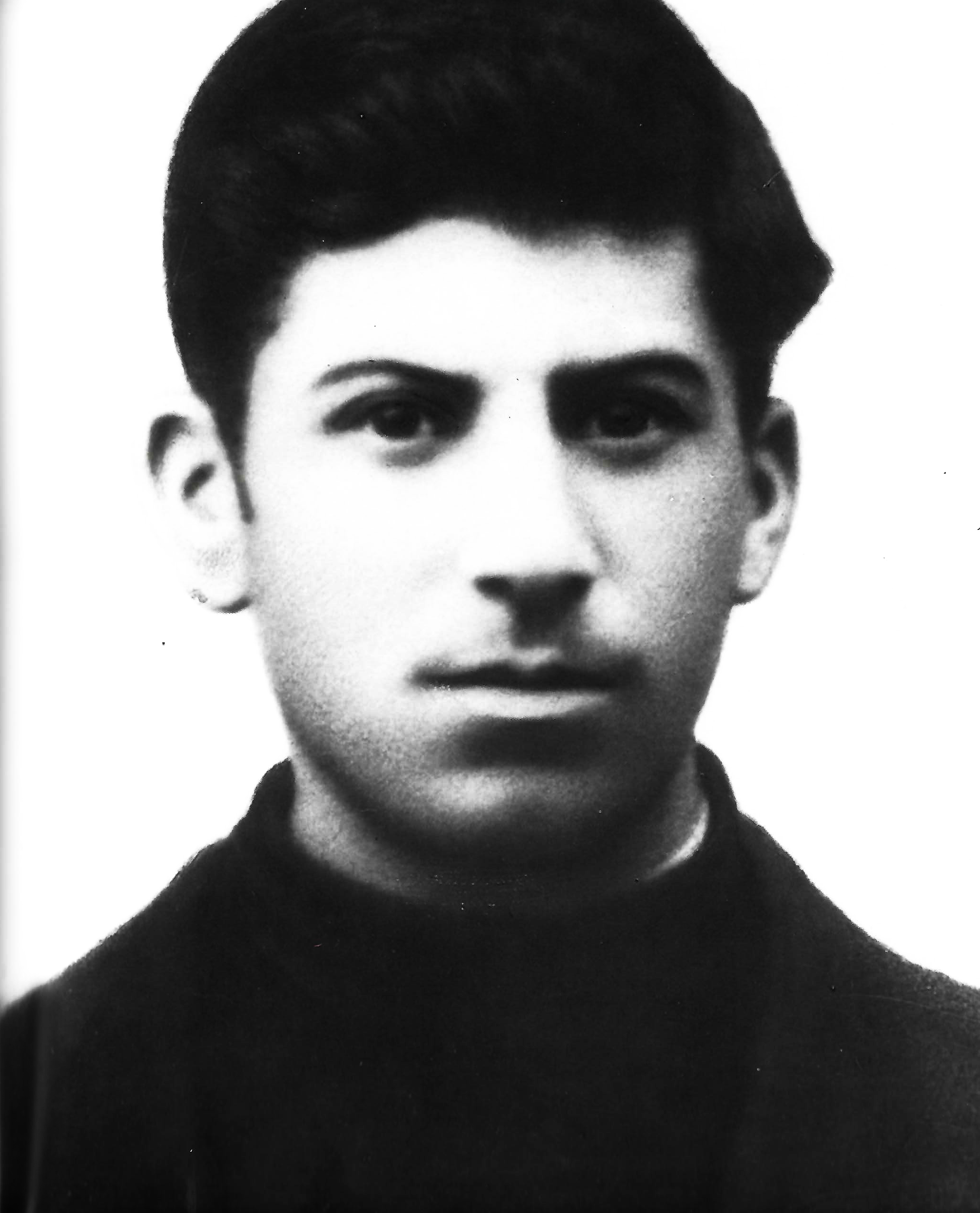
Early Life in Gori: Beatings, Poverty, and Bitterness
In Animal Farm we meet the pig Napoleon. Napoleon represents Joseph Stalin, the terrorist ruler of Soviet Russia. Stalin’s boyhood nickname was ‘Soso’, a sobriquet given by his mother. He would abandon his boyhood nickname for the more heroic “Koba”, and once he became a professional revolutionary, he took the name Stalin, “Man of Steel”.

Joseph Vassarionev Jugashvilli was born in 1878 in Gori, Georgia, a small town in the southern foothills of the Caucasus Mountains. His father Beso Jugashvilli was a cobbler, and a mean drunkard consumed by anger. His only child Joseph (Soso) and Joseph’s mother (Keke) were often the victims of Beso’s merciless beatings. For a few years, the family of three lived in a one-room, brick hovel in the poor section of town. From his father, Soso learned cruelty and cynicism. His father beat him for no reason, and his mother beat him for disobedience. Soso became accustomed to the beatings, but he was embittered by his circumstances. Soso grew to hate his poverty-stricken boyhood, so filled with beatings from his father and mother alike, and also filled with hunger.
Soso also learned at a young age to hate Jews. The Jews he knew were rich, but Soso was poor. In spite of the fact that many Jews befriended Soso because his mother did their laundry, and he was often in their houses, accepting their largesse, he still learned to hate them. He was an antisemite his whole life.
At an early age, Soso learned to love a children’s boxing game called “krivi”. In the game he was taught to answer blow for blow. Soso also learned early that he had a knack for dominating others and organizing them. Indeed, the best child boxer in Gori, who was several years older than Soso, submitted to Soso’s leadership. Apparently, the older boy admired Soso’s fanatical determination to always come out on top.
Soso’s mother Keke recognized Soso’s intelligence and his innate leadership. She was determined that her son be educated. To escape the abusive relationship of her husband, Keke took Soso and moved into the house of a family friend, the Russian Orthodox priest Father Christopher Charkviani. Charkviani’s sons taught Soso to read and write Russian.
In 1888, when Soso turned ten years old, Keke sent him to the Gori Church School. By this time Keke and Beso were separated. Keke made a living by doing laundry for well-to-do patrons in Gori. Her husband offered his family no support.

Soso excelled academically and as a choirboy, singing harmony with other boys in church and at local weddings. Soso is remembered as being the best student in the class, but also the most mischievous. True to his natural leadership skills, Soso formed a gang of mischief-makers.
As a young boy, Soso was crippled in his left arm by an accident. As he grew up, Soso was often humiliated by the way his arm looked. He also had a pockmarked face from a bout of smallpox when he was a toddler, and he was small for his age. As compensation for any kind of mockery thrown his way for his stature, his face, his arm, his poverty, or his drunkard of a father, Soso often planned a spiteful revenge upon anyone foolish enough to make a joke out of Joseph Jugashvilli. One day a fellow student mocked Soso for his deformities. Soso waited, then instructed the strongest boy in town to give the mocker a savage beating that he would never forget. When Soso grew up to become Joseph Stalin, one of his favorite tactics with his perceived enemies was to let them alone after confronting them. Then Stalin would instruct one of his henchmen to arrest the enemy and throw him in prison, where he would either be shot or sent to a Siberian labor camp. This happened hundreds of times.
The Seminary Years: From Orthodox Student to Revolutionary
At sixteen, after graduating at the head of his class in the Gori school, Soso was enrolled in the Russian Orthodox Seminary in Tiflis, Georgia. Life at the seminary was a dreary sojourn for Soso. The young men were being prepared to be Orthodox priests. While in school, Soso had taken as a hero a fictitious Robin Hood type called Koba, a highwayman who robbed from the rich and gave to the poor. Just as he had learned to hate his mother’s and father’s beatings, Soso learned to hate the strict Orthodox training, and he found another creed besides Orthodoxy.
At this time in Russia, the exile system of criminal punishment was still being used. In fact it never stopped, even when the Communists took power. Socialists who had been exiled to Georgia settled in Tbilisi, and they introduced him and other seminarians to communism.
Communism’s goal was to remake the world and make equality for all men a reality. But to achieve this dream, the revolutionary had to break off from the laws of the civilized world. “Our task is terrible, universal destruction”, wrote Mikhail Bakunin, the father of Russian anarchism.
“A revolutionary must be merciless, expect no mercy for himself, and be ready to die….He must ally himself with criminals, who are the only true revolutionaries in Russia.” -Mikhail Bakunin, The Revolutionary Catechism
Reading this catechism at night after lights in the seminary were put out, Soso became a believer in communism. He believed that only revolutionary terror could change the world for the better- by hastening the collapse of the capitalist system. He had a new religion. He stopped believing in God and started believing in Darwin. In his heart and soul, Soso Jugashvilli became Koba, the romantic highwayman, fearlessly robbing the rich to give to the poor, believing in Bakunin’s words, “The true revolutionary must be merciless and not afraid of blood.” In 1899, at the age of twenty-one, Joseph Vassarionev Jugashvilli (Soso) was expelled from seminary for the possession of Marxist propaganda. He had become a revolutionary.
Find out more about how Stalin’s belief in communism ruined his country of Russia in our study of Animal Farm.